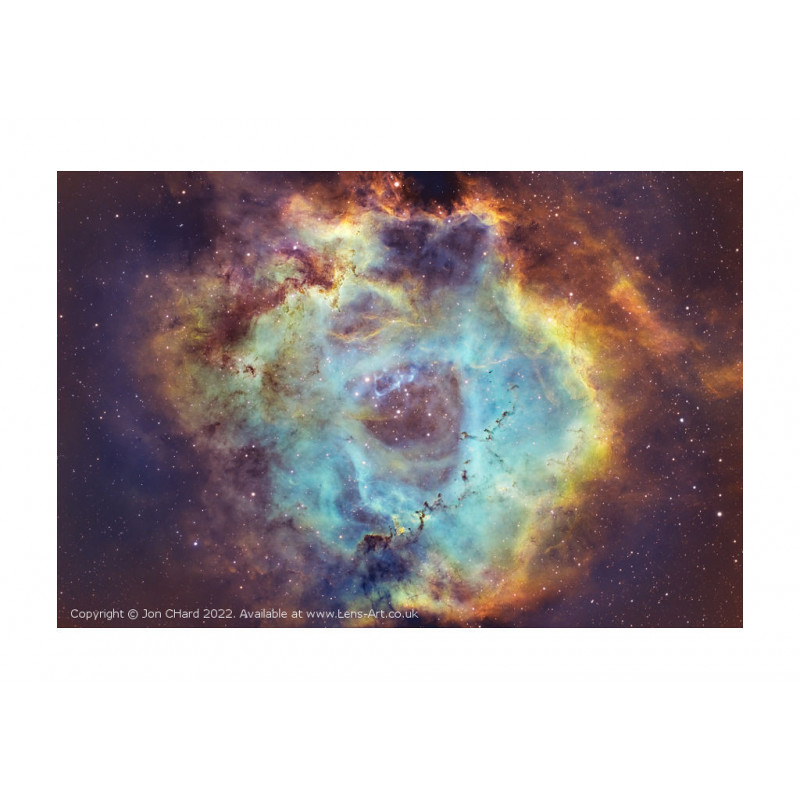

Long exposure photograph of the Rosette Nebula.
Available as Canvas, Fine Art and Welsh Slate Print.
Product customisation
Don't forget to save your customization to be able to add to cart Security policy
Secure SSL Payments via Paypal
 Delivery policy
Free UK Delivery - 5 Working Days. See Terms and Conditions.
 Return policy
See our Terms and Conditions
The Rosette Nebula (also known as Caldwell 49) is an H II region located near one end of a giant molecular cloud in the Monoceros region of the Milky Way Galaxy. The open cluster NGC 2244 (Caldwell 50) is closely associated with the nebulosity, the stars of the cluster having been formed from the nebula's matter.
The cluster and nebula lie at a distance of 5,000 light-years from Earth and measure roughly 130 light years in diameter. The radiation from the young stars excites the atoms in the nebula, causing them to emit radiation themselves producing the emission nebula we see. The mass of the nebula is estimated to be around 10,000 solar masses.
A survey of the nebula with the Chandra X-ray Observatory has revealed the presence of numerous new-born stars inside optical Rosette Nebula and studded within a dense molecular cloud. Altogether, approximately 2500 young stars lie in this star-forming complex, including the massive O-type stars HD 46223 and HD 46150, which are primarily responsible for blowing the ionized bubble. Most of the ongoing star-formation activity is occurring in the dense molecular cloud to the south east of the bubble.
Data sheet
Long exposure photograph of the Rosette Nebula.
Available as Canvas, Fine Art and Welsh Slate Print.