- -10%
- New
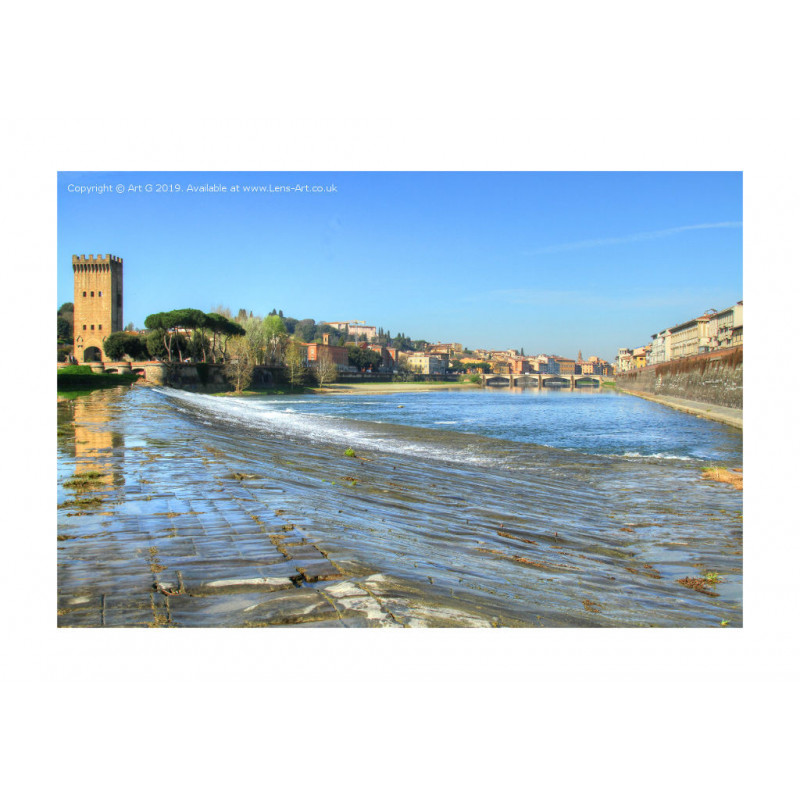

Photograph looking East along the Arno River in Florence.
Available as Canvas, Fine Art and Welsh Slate Print.
Product customisation
Don't forget to save your customization to be able to add to cart Security policy
Secure SSL Payments via Paypal
 Delivery policy
Free UK Delivery - 5 Working Days. See Terms and Conditions.
 Return policy
See our Terms and Conditions
This view looking East along the Arno River in Florence, and facing the Ponte Alle Grazie bridge, was shot from on top of the San Niccolo weir. I managed to find a relatively dry spot, but it was still pretty precarious... trying to keep my balance while taking 3 separate exposures hand held, feeling my feet slipping from under me all the while.
Crouched down on tiptoes I had originally tried single exposures but even in March the sun was still harsh enough to cause exposure issues, resulting in either an overexposed sky or underexposed landscape (particularly in the foreground). The only way to get the image above was through merging 3 different exposures in Photomatix and subtle use of HDR to balance the exposure perfectly.
The Wool Merchants' Guild owned numerous facilities on the river, such as a fulling mill, used in the various cycles of processing wool and fabrics. San Niccolo weir was used to furnish these mills with water needed in the production of woolen fabrics and to provide drinking water to the local population in Florence.
The Arno River itself flows through the Italian region of Tuscany and is the most important river in central Italy after the River Tiber. The Arno River's source is on the southern slope of Mount Falterona, and it's 241km journey takes it through Arezzo, Empoli, Florence and finally Pisa before flowing into the Tyrrhenian Sea.
The Ponte Alle Grazie bridge seen in the background was originally constructed in 1227, was rebuilt in 1345 and in the 17th Century two of the arches were filled and chapels were erected at each of the pylons which were later used as houses for nuns until they were cleared in the 1870's. The bridge you see today was built in 1953 after the aforementioned iteration was destroyed by retreating Germans in 1944.
Data sheet
Photograph looking East along the Arno River in Florence.
Available as Canvas, Fine Art and Welsh Slate Print.