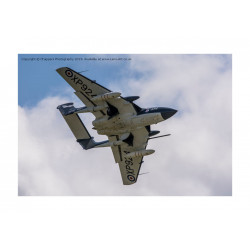


Photograph of a Handley Page Victor with drag chute deployed at Bruntingthorpe.
Available as Canvas and Fine Art Print.
 Security policy
Secure SSL Payments via Paypal
 Delivery policy
Free UK Delivery - 5 Working Days. See Terms and Conditions.
 Return policy
See our Terms and Conditions
The Handley Page Victor is a British-built Jet-powered aircraft, initially designed as a heavy bomber as part of the UK’s airborne nuclear deterrent strategy during the cold war. It was the third and final ‘V-Bomber’ to enter Royal Air Force service and also the last one to retire. After RAF tactics were switched to low-altitude attacks in 1968 the victor was found to be unsuitable for bombing duties due to the discovery of fatigue cracks in the airframes.
At this time a number of Victors were modified for strategic reconnaissance, using a combination of radar, cameras and other high-tech sensors. However, with the Polaris submarines taken over the nuclear deterrent role the V-bomber fleet was slowly disbanded. The Victors were able to continue service after being converted to aerial refuelling tankers and were a key aspect in the successful bombing of Port Stanley runway during the Falkland’s War via providing air-to-air support to the Avro Vulcan bombers.
The Victor was the last of the V-bombers to leave RAF service, just after seeing action during the first Gulf war with the final aircraft was removed from service on 15 October 1993. It was replaced by the Vickers VC10 and Lockheed Tristar.
Handley Page Victor XM715 ‘Teasin’ Tina’ is one of only two surviving K2 Tankers that remains in serviceable condition. It is still capable of taxiing at full speed and can be seen doing so on a regular basis as part of the cold war jets collection at Bruntingthorpe Aerodrome.
Data sheet
Photograph of a Handley Page Victor with drag chute deployed at Bruntingthorpe.
Available as Canvas and Fine Art Print.