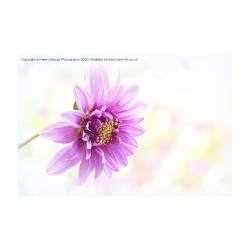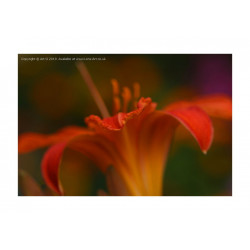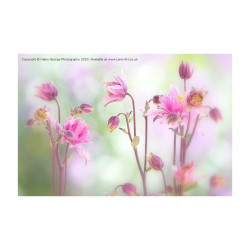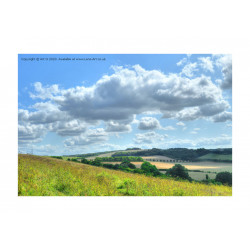


Photograph of a Great Willowherb wildflower at Titchfield Canal.
Available as Canvas, Fine Art and Welsh Slate Print.
Product customisation
Don't forget to save your customization to be able to add to cart Security policy
Secure SSL Payments via Paypal
 Delivery policy
Free UK Delivery - 5 Working Days. See Terms and Conditions.
 Return policy
See our Terms and Conditions
The Great Willowherb or 'Epilobium Hirsutum' is a wildflower of the genus Epilobium in the family 'Onigracea'. Whilst Great Willowherb is it's most common name, it also have a variety of local names such as 'apple pie', 'cherry pie' and 'codlins and cream' (codlins being a small sour cooking apple which were boiled in milk and eaten with cream).
The Great Willowherb flowers for 2 months of the year in July and August, and is commonly found in damp ground, such as riversides, grasslands, ditches and woodland clearings. The flowers have a rosy colour and the stigma's are creamy white, and it is this colour combination which is believed to have led to some of the common names the plant has. The leaves and stems are very woolly, referred to by the specific latin term 'hirsutum' which means hairy.
Whilst the leaves of the Great Willowherb have been used as an astringent, there have been reports of violent poisoning, with epileptic-like convulsions, The leaves of the closely related 'Rose Bay Willowherb' however have been used as a substitute and adulterant of Tea. Though no longer so employed in England, the leaves of both this species and of the Great Hairy Willow-herb (E. hirsutum, Linn.) are largely used in Russia, under the name of Kaporie Tea.
This photo was captured a mile or so south of Titchfield on the old canal path which runs alongside this previously navigable stretch of the River Meon. Until the late 17th century, Titchfield was a significant port, until trade moved to neighbouring Southampton and Portsmouth as the navigation, which had been opened in 1611 began to silt up and restrict the passage of ships. When the canal was constructed, the outfall of the River Meon to the sea was dammed, creating the wetlands that now form Titchfield Haven Nature Reserve.
Data sheet
Photograph of a Great Willowherb wildflower at Titchfield Canal.
Available as Canvas, Fine Art and Welsh Slate Print.