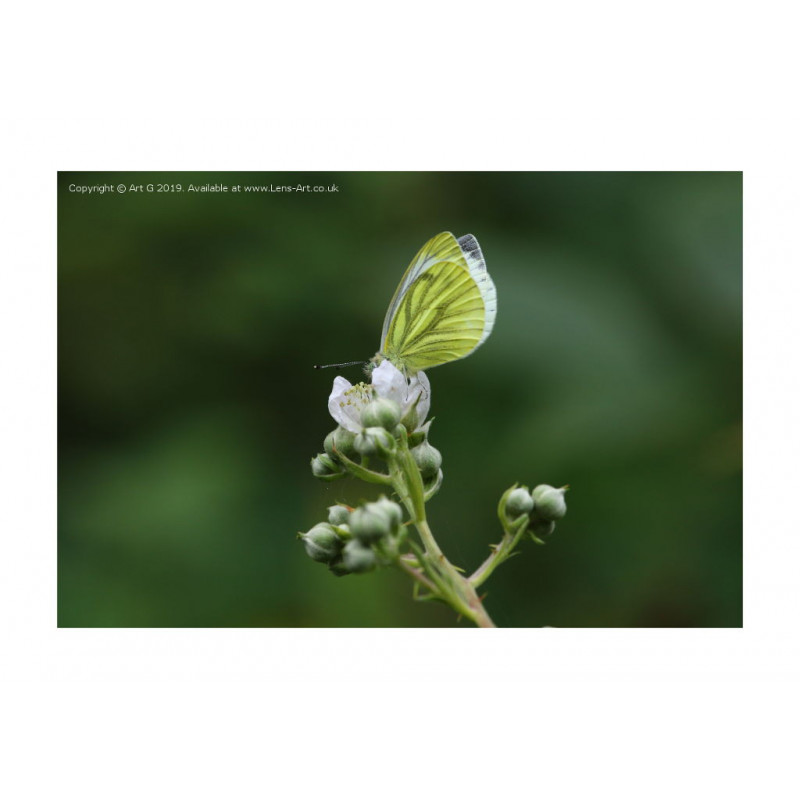

Photograph of a Green Veined White butterfly at Blashford Lakes.
Available as Canvas, Fine Art and Welsh Slate Print.
 Security policy
Secure SSL Payments via Paypal
 Delivery policy
Free UK Delivery - 5 Working Days. See Terms and Conditions.
 Return policy
See our Terms and Conditions
The Green Veined White is one of the most widespread species of butterfly across the British Isles, and can be found all across England and Wales, and into the southern parts of Scotland. It is noticeably absent from the far north and Shetland Isles, which could be down to the colder weather at both end of this insects season (typically March until October).
The green veins are not actually green but an optical illusion created by a mix of yellow and black scales on the underside of this butterflies' wings, while the top side is slight off white colour, with a small spot on each forewing that becomes more pronounced as the months go by. Increasing also in size as the summer approaches, those in the south are typically smaller, but with slightly brighter underwings than their northerly counterparts.
This photo was taken at Blashford Lakes, a Hampshire and Isle of Wight Trust nature reserve situated on the Hampshire and Dorset border, close to the New Forest National Park. Successfully created by flooding disused gravel pits, Blashford is popular amongst bird watchers and photographers, as the reserve fills up with thousands of waterfowl during the winter months, with Geese, Egrets and Herons aplenty.
There are a good number of butterflies here, but it is the dragonflies which are in abundance in the summer months, and then of course there are the Blashford Kingfishers which see the hides fill up with long lenses on a regular basis. The best hide for photographing Kingfishers is the Goosander Hide, where a 400mm lens will usually be sufficient to catch the Kingfisher on one of the branches or posts in the water just below you (if you are using an aps-c camera such as the Canon 7d mark ii or the Nikon D500).
Even with the equipment above you would likely need to do a little cropping, so a longer lens such as the Sigma 150-600 would be much more ideal. For photographers with Full Frame sensors you may find that 400mm doesnt cut it, therefore you really should be looking at the longer lenses. For find out more about Blashford Lakes visit: www.hiwwt.org.uk/reserves/blashford-lakes.
Data sheet
Photograph of a Green Veined White butterfly at Blashford Lakes.
Available as Canvas, Fine Art and Welsh Slate Print.